
|
|
The purpose of this module is to build on prior learning in infusion therapy. This learning resource was developed to facilitate a review of infusion therapy as you prepare for clinical courses in the Post LPN-BN program.
This is a self-study module. There is no tutor for this module.
All students perform clinical skills in accordance with policies and procedures of the health region/authority in which they are practicing.
Infusion therapy is one of the most common interventions in health care. It is an efficient way to deliver medications and fluids to the acutely ill patient. The purpose of this module is to provide the student with a review of infusion therapy. Information specific to infusion pumps and equipment used in Calgary and Edmonton clinical placements is included. You will have the opportunity to practice priming an infusion line in your own home.
Upon completion of A Practical Review of Infusion Therapy, the student will:

1. Complete Section One: Purpose of Infusion Therapy, Solutions, and Supplies (pp. 8 – 21) in the following independent learning module, Peripheral Vascular Access Device (VAD) Insertion Learning Module (Alberta Health Services, 2014). http://charon.athabascau.ca/cnhsundergrad/401e5/activities/IVmodule.pdf
2. Read Chapter 8.3: IV Fluids, IV Tubing, and Assessment of IV System in Clinical Procedures for Safer Patient Care (Doyle & McCutcheon, 2015). https://opentextbc.ca/clinicalskills/chapter/8-2-types-of-iv-therapy/
3. Complete Unit 9: Intravenous Solutions, Equipment, and Route of Medication in the Medmath Module http://charon.athabascau.ca/cnhsundergrad/medmath/unit9.htm
4. View Video: Isotonic, Hypotonic, Hypertonic IV Solutions Made Easy to understand the different types of solutions (Registered Nurses RN, 2016). https://www.youtube.com/watch?v=51FkahHUBwc
5. Hignell (2018) listed supplies needed for a successful initiation of peripheral intravenous:

A doctor’s order is required for the insertion of a peripheral IV catheter. The order must include the type of IV solution, the rate of infusion, the most responsible health practitioner’s signature, and the date (Alberta Health Services, 2017).

1. Complete Section Two: Selecting an Insertion Site (pp. 22 – 26) in the following independent learning module, Peripheral Vascular Access Device (VAD) Insertion Learning Module (Alberta Health Services, 2014). http://charon.athabascau.ca/cnhsundergrad/401e5/activities/IVmodule.pdf
2. Complete Section Three: Inserting a Peripheral Vascular Access Device (pp. 27 – 41) in the following independent learning module, Peripheral Vascular Access Device (VAD) Insertion Learning Module (Alberta Health Services, 2014). http://charon.athabascau.ca/cnhsundergrad/401e5/activities/IVmodule.pdf
3. View Video: IV Insertion from Nursing Skills Laboratory Online, University of Cincinnati, Blue Ash College (n.d.). http://hawknurse.weebly.com/iv-insertion.html

Nurses provide safe, competent, and ethical care. Consult health region/authority policy and procedure prior to performing venipuncture. There should be no more than two attempts per clinician. Know your limitations. Do not attempt to place an access device into a patient when access is difficult. Patients with prominent veins are recommended for novice nurses, as this will increase both the confidence and skill level of the novice nurse.
1. Complete Section Four: Maintaining a Peripheral Vascular Access Device and Managing Complications (pp. 42 – 52) in the following independent learning module, Peripheral Vascular Access Device (VAD) Insertion Learning Module (Alberta Health Services, 2014). http://charon.athabascau.ca/cnhsundergrad/401e5/activities/IVmodule.pdf
2. Complete Section Five: Discontinuing a Peripheral Vascular Access Device (pp. 53 – 55) in the following independent learning module, Peripheral Vascular Access Device (VAD) Insertion Learning Module (Alberta Health Services, 2014). http://charon.athabascau.ca/cnhsundergrad/401e5/activities/IVmodule.pdf
3. View Videos:
4. Read: Chapter 8.3 IV Fluids, IV tubing, and Assessment of an IV System https://opentextbc.ca/clinicalskills/chapter/8-2-types-of-iv-therapy/ (Doyle & McCutcheon, 2015).

Nurses provide safe, competent, and ethical care. It is always important to consult your health region/authority policy and procedure on the management of peripheral infusion therapy.
1. Complete: The following independent learning module, Transfusion of Blood Components and Products (Alberta Health Services, 2017). https://www.albertahealthservices.ca/assets/wf/lab/wf-lab-clin-tm-manual-lm.pdf
2. View Videos:
3. Complete Unit 8: Reconstitution of Medication in the Medmath Module https://cnhs.lms.athabascau.ca/course/view.php?id=3192
4. Complete Unit 10: IV Flow Rate Calculations in the Medmath Module. https://cnhs.lms.athabascau.ca/course/view.php?id=3192
5. Read Chapter 7.6: Administering Intermittent Intravenous Medication (Secondary Medication) and Continuous IV Infusions (Doyle & McCutcheon, 2015). https://opentextbc.ca/clinicalskills/chapter/6-11-administering-intravenous-medications-by-piggyback-mini-bags-intermittent-infusion-sets-and-mini-infusion-pumps/
6. To safely reconstitute powdered drugs, review the following six steps to ensure a good quality mixture.
7. Learning how to read a parenteral monograph is important for infusion therapy medication administration and for patient safety. Completing the two case studies (located on the course home page) on the medications dimenhydrinate and pantoprazole will enhance your ability to read and understand parenteral monographs.

To provide safe and ethical patient care, nurses should be competent in medication calculation and follow the rights of medication administration. A doctor’s order is required to infuse IV medications and blood products, and at times a second check must also be done.

1. Complete: The following independent learning module, Central Venous Access Device (CVAD) Learning Module (Alberta Health Services, 2019).
2. View Videos:
Central Line Dressing Change – Nursing Skills (EmpoweRN, 2015) https://www.youtube.com/watch?v=37d3wVulWcw
Central Lines /skills: Flushing the line. (American College of Surgeons, 2016) https://www.youtube.com/watch?v=EwGXQ-CsZGU

To minimize health and safety risks to patients, prior to procedures, consult health region/authority policy and procedure. Here is a link to Alberta Health Services, Clinical Policies and Procedures https://www.albertahealthservices.ca/info/Page7451.aspx
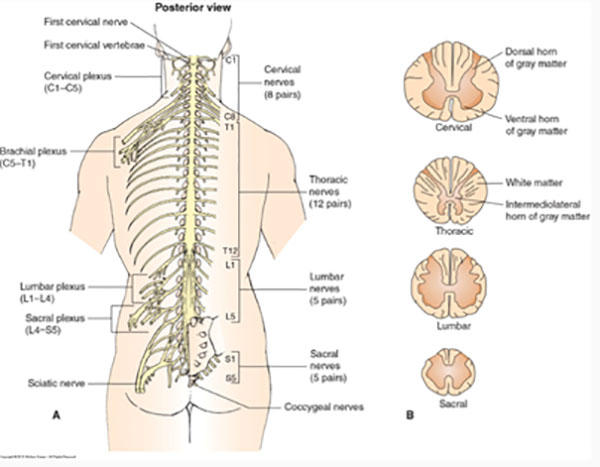
1. Review: Grey Nuns and Misericordia Sites, Certification Module for Epidural/Spinal Analgesia/Anesthesia (Covenant Health, 2018) http://extcontent.covenanthealth.ca/Policy/vii-a-15%20Epidural%20Certification%20Package.pdf
Note: you may get a security error when you access this document. You can proceed without any concerns.
2. View Videos:
Epidural Sensory and Motor Assessment (Western Health, 2012). https://www.youtube.com/watch?v=ix5_Pwsuf2k
Alaris PCA (Nash-Arnold, 2013). https://www.youtube.com/watch?v=ecqouMRhORs

As a student you will not be independently assessing these sites nor will you be administering medication through these sites. However, it is important to understand this restricted activity skill as you will care for patients receiving this therapy in your practicum. Reflect and improve on your current knowledge of epidural infusions.
Before you begin: Focus your learning on the infusion pumps that will be used in your clinical area of practice. The smart infusion pumps differ between Calgary and Edmonton.
Smart Pumps for Clinical Practice in Calgary, AB
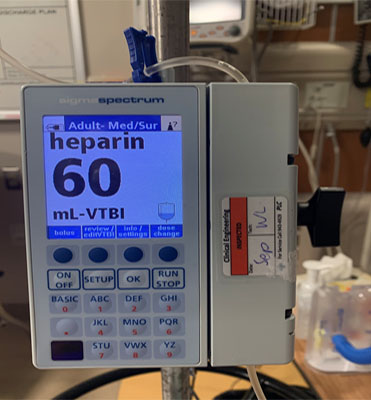
1. Watch videos, to learn about the pumps you will use in Calgary, AB.
2. Peruse Baxter’s Sigma Pump Operator’s Manual if you are interested in learning more (start on page 11). https://infusystem.com/images/manuals/Sigma%20Spectrum.pdf
Smart Pumps for Clinical Practice in Edmonton, AB
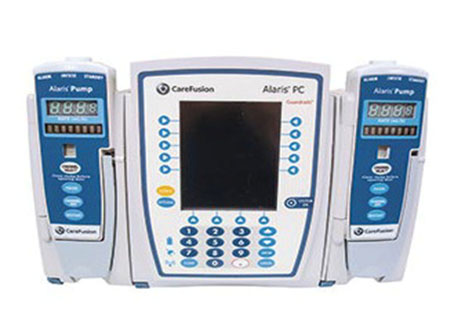
1. Watch video, to learn about the pump you will use in Edmonton, AB.
2. Read the Directions for Use, Alaris System (2009) if you are interested in learning more. http://static1.1.sqspcdn.com/static/f/1024263/13901185/1314646481840/Alaris_System_DFU_Model_8015_092009.pdf?token=6iRhSXm6HyLCZgbuD7%2B8tFYnpR0%3D
3. Athabasca University. Alaris Pump video (Coming Soon)
Additional Resources
Medication Safety and Calculation Module. (n.d.). https://cnhs.lms.athabascau.ca/course/view.php?id=3192
Doyle, G. R., & McCutcheon, J. A. (2015). Clinical procedures for safer patient care. BC Campus. https://opentextbc.ca/clinicalskills/
Hignell, P. (2018). Peripheral intravenous initiation: Self-learning module (8th ed.). Fraser Health. https://www.fraserhealth.ca/-/media/Project/FraserHealth/FraserHealth/Health-Professionals/Professionals-Resources/Acute-Care-Orientation/IV-Initiation-Self-Learning-Module-v8-June-2018.pdf?la=en&hash=320E955A6C95F3DB852E19EDA581864941EF06A1
Reflection

“Champions do not become champions when they win the event, but in the hours, weeks, months and years they spend preparing for it. The victorious performance itself is merely the demonstration of their championship character.”
Alan Armstrong (Goodreads, n.d.)
3M Health Care. (2015, December 1). I.V. port dressing. Tegaderm Transparent Dressing 1668 Application [Video]. YouTube. https://www.youtube.com/watch?v=eOeVkphtSq8
Alberta Health Services. (n.d.). Clinical policy and procedures. https://www.youtube.com/watch?v=TnSmjDDRwkg
Alberta Health Services. (2014, December). Professional Development: Peripheral Vascular Access Device (VAD) Insertion Learning Module. http://charon.athabascau.ca/cnhsundergrad/401e5/activities/IVmodule.pdf
Alberta Health Services. (2017, January). Professional Development: Transfusion of Blood Components and Products. https://www.albertahealthservices.ca/assets/wf/lab/wf-lab-clin-tm-manual-lm.pdf
Alberta Health Services. (2019). Professional Development: Central Venous Access Device (CVAD) Learning Module.
Athabasca University (n.d.). Medication Math module, Unit 8. Reconstitution of medication. https://cnhs.lms.athabascau.ca/course/view.php?id=3192
Athabasca University (n.d.). Medication Math Module, Unit 9: Intravenous Solutions, Equipment, and Route of Medication http://charon.athabascau.ca/cnhsundergrad/medmath/unit9.htm
Athabasca University (n.d.). Medication Math Module, Unit 10. IV flow rate calculations https://cnhs.lms.athabascau.ca/course/view.php?id=3192
Baxter. (2011). Sigma pump operator’s manual. https://infusystem.com/images/manuals/Sigma%20Spectrum.pdf
Baxter. (2012). SIGMA Spectrum infusion system receives best in KLAS award for second consecutive year. https://www.youtube.com/watch?v=oo5_GsK6tjk
Baxter. (2012). Sigma Spectrum Infusion Pump: Overview and Basic Infusion https://www.youtube.com/watch?v=sA5R0g7xar0
CareFusion. (2009). Directions for use. Alaris system. http://static1.1.sqspcdn.com/static/f/1024263/13901185/1314646481840/Alaris_System_DFU_Model_8015_092009.pdf?token=6iRhSXm6HyLCZgbuD7%2B8tFYnpR0%3D
Covenant Health. (2018) Certification Module for Epidural/Spinal Analgesia/Anesthesia (http://extcontent.covenanthealth.ca/Policy/vii-a-15%20Epidural%20Certification%20Package.pdf
Doyle, G. R., & McCutcheon, J. A. (2015). Chapter 7.6: Administering intermittent intravenous medication (secondary medication) and continuous IV infusions Clinical procedures for safer patient care. BC Campus. https://opentextbc.ca/clinicalskills/chapter/6-11-administering-intravenous-medications-by-piggyback-mini-bags-intermittent-infusion-sets-and-mini-infusion-pumps/
Doyle, G. R., & McCutcheon, J. A. (2015). Chapter 8.3: IV fluids, IV tubing, and assessment of an IV system. Clinical procedures for safer patient care. BC Campus. https://opentextbc.ca/clinicalskills/chapter/8-2-types-of-iv-therapy/
F.A. Davis (2015). Davis’ nursing skills videos for RNs. Discontinuing a peripheral IV [Video]. Vimeo. https://vimeopro.com/fadavis/wilkinson-skills-videos-3e/video/121281010
GoodReads (n.d.). Preparation Quotes. https://www.goodreads.com/quotes/tag/preparation
Hadaway, L. (Ed.). (2018). Infusion therapy made incredibly easy! (5th ed.). Wolters Kluwer.
Hignell, P. (2018). Peripheral intravenous initiation: Self-learning module (8th ed.). Fraser Health. https://www.fraserhealth.ca/-/media/Project/FraserHealth/FraserHealth/Health-Professionals/Professionals-Resources/Acute-Care-Orientation/IV-Initiation-Self-Learning-Module-v8-June-2018.pdf?la=en&hash=320E955A6C95F3DB852E19EDA581864941EF06A1
Mann, J. (2019). Personal photos, India
Medical Exam Tutor. (2015). Reconstituting IV drugs. https://www.youtube.com/watch?v=w_MJ5ypOILM
Med One Group (2019, March 7). Alaris 8100 Pump Module Training [Video]. YouTube. https://www.youtube.com/watch?v=Fyth0syNTP4
Nash-Arnold, N. (2013). Brisbane Northside Emergency. Alaris PCA [Video]. YouTube. https://www.youtube.com/watch?v=ecqouMRhORs
NCLEX Study Guide. (2016). Top tips for blood transfusion (NCLEX RN Review). https://www.youtube.com/watch?v=VyZD9scwCA8
NursingFile (2011). Changing and flushing a central line access cap. https://www.youtube.com/watch?v=TnSmjDDRwkg
NursingFile (2011). Intravenous (IV) therapy: Converting an IV to a saline lock [Video]. YouTube. https://www.youtube.com/watch?v=2CVHxXLYMU8
NursingFile. (2011). IV Regulating Infusion Flow Rate by Gravity Drip. https://www.youtube.com/watch?v=-i5_v1AEGlo
NursingFile. (2011). Adding medication to IV solution bag. https://www.youtube.com/watch?v=yMOWBJ9FIoo
Porth, C.M. (2015). Essentials of pathophysiology: Concepts of altered health states (4th ed.). Wolters Kluwer.
Registered Nurses RN (2016, January 11). Isotonic, hypotonic, hypertonic IV solutions made easy/Fluid electrolytes nursing students [Video]. YouTube. https://www.youtube.com/watch?v=51FkahHUBwc
Sigma Spectrum (n.d.). Operator’s manual. https://infusystem.com/images/manuals/Sigma%20Spectrum.pdf
Teleflex (n.d.). The history of the arrow vascular access brand [Image]. https://www.teleflex.com/usa/en/product-areas/vascular-access/timeline/index
Unity Point Health, Meriter Nursing Education (2014, June 26). Secondary infusion [Video]. YouTube. https://www.youtube.com/watch?v=84B_94taIas
University of Alberta (2012, February 9). Teaching and Learning, University of Alberta Nursing. Flushing a central line [Video]. YouTube. https://www.youtube.com/watch?v=mPOwY6-kX-8&list=PL579C06EADD54801C&index=3&t=0s
University of Alberta Nursing (2014, December 18). Teaching and Learning, University of Alberta Nursing. Central venous access dressing change and injection cap change [Video]. YouTube. https://www.youtube.com/watch?v=b1AgE8gdPEA&t=16s
University of Cincinnati, Blue Ash College (n.d.). Nursing Skills Laboratory Online. IV insertion [Video]. http://hawknurse.weebly.com/iv-insertion.html
Western Health (2012, Jul 6). Epidural sensory and motor assessment [Video]. YouTube. https://www.youtube.com/watch?v=ix5_Pwsuf2k
Wordcloud. (n.d.). https://www.wordclouds.com
Last updated: September 1, 2021 ©
Copyright Athabasca
University
For questions, comments or to report broken links, email: CNHS Web